
Last updated: November 23, 2026
Quick answer: A tankless water heater heats water on demand, uses less energy and lasts longer, but costs more to install and may need a larger gas line and new venting. A tank heater is cheaper up front and simple to replace, but stores hot water you pay to keep warm and can run out during heavy use.
Tankless vs tank at a glance
| Tank water heater | Tankless water heater | |
|---|---|---|
| How it heats | Keeps 40–80 gallons hot around the clock | Heats water only when a tap is open |
| Hot water supply | Can run out after long or back-to-back showers | Continuous, limited by flow rate |
| Energy use | Standby heat loss from the tank | No standby loss; usually lower bills |
| Typical lifespan | About 8–12 years | About 15–20 years with descaling |
| Space | Large tank in a garage, closet or attic | Wall-mounted, compact |
| Up-front cost | Lower | Higher, especially when converting |
| Maintenance | Flush sediment yearly | Descale regularly in hard-water areas |
How each system works
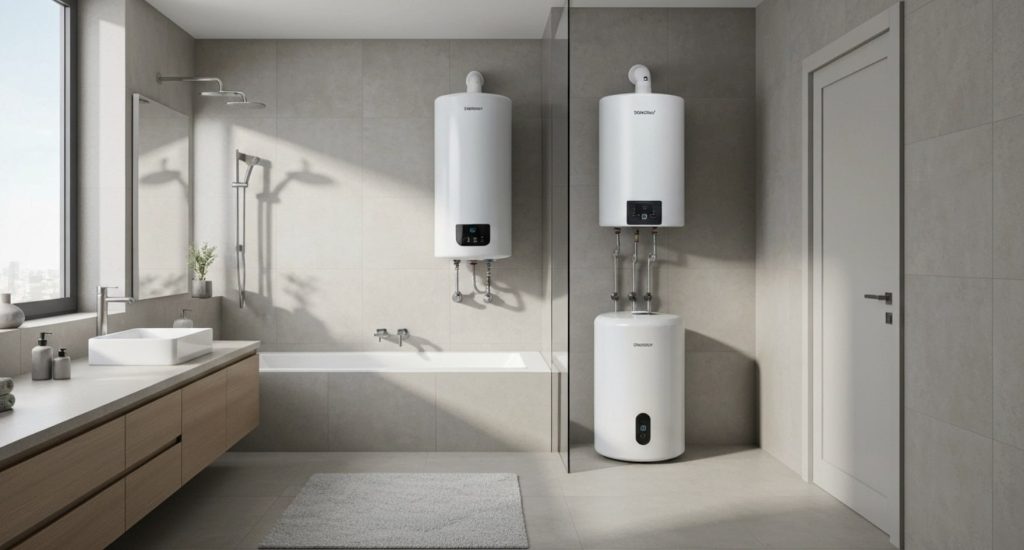
A tank water heater fills a storage tank and keeps it at a set temperature with a gas burner or electric elements. When you open a hot tap, hot water leaves the top of the tank and cold water refills the bottom. Once the tank is used up, you wait for it to reheat.
A tankless water heater has no storage. When it senses water flowing, a powerful burner or element heats the water as it passes through a heat exchanger. You get hot water as long as the flow stays within the unit’s capacity, measured in gallons per minute.
Which is better for your home?
Choose tankless if
- You regularly run out of hot water or have a large household
- You plan to stay in the home long enough to recover the higher installation cost through lower energy bills and a longer lifespan
- You need to free up space in a garage or closet
- Your gas supply and venting can support the unit (a plumber checks this)
Choose a tank if
- Your current tank has failed and you need the simplest, quickest replacement
- Your hot water use is modest
- Upgrading the gas line, venting or electrical service for tankless would cost more than it saves
What Southern California homeowners should know
Hard water. Much of Los Angeles and Orange County has hard water. Minerals build up as sediment in tanks and as scale inside tankless heat exchangers. Tankless units need periodic descaling, and a water softener or whole-house filtration system can extend the life of either type.
Gas line and venting. Gas tankless heaters need much more fuel when they fire than a tank does, so older homes often need a larger gas line from the meter, and the unit needs its own venting. That conversion work is the biggest variable in the cost of switching.
Earthquake strapping. California Health & Safety Code §19211 requires new and replacement water heaters to be braced, anchored or strapped against earthquake movement. Tank heaters need seismic straps; tankless units are wall-mounted. We include the required strapping with every installation.
In larger homes, such as many in Calabasas and Anaheim Hills, a tankless unit (or two) combined with a recirculation pump can deliver hot water to distant bathrooms faster. Our Calabasas team and our Anaheim team install both systems.
What affects the cost
- Unit type, fuel (gas or electric) and capacity
- Converting from tank to tankless: gas line upsizing, new venting, condensate drain, electrical outlet
- Location and access (garage, closet, attic, exterior wall)
- Permits and code updates such as strapping, expansion tanks and pressure-relief lines
- Removal and disposal of the old heater
We give you a written price for the complete job before we start, so you can compare both options side by side.
Sizing a tankless or tank heater
Tank heaters are sized by capacity and “first-hour rating,” the amount of hot water they can deliver in an hour starting with a full tank. A household that runs two showers and a dishwasher in the morning needs a higher first-hour rating than a couple who shower at different times.
Tankless heaters are sized by flow rate (gallons per minute) at the temperature rise you need. Add up the fixtures you might run at the same time (a shower uses roughly 1.5–2.5 gpm, a kitchen faucet about 1.5 gpm) and choose a unit that can heat that flow. Incoming water in Southern California is relatively warm most of the year, which helps tankless units reach their rated flow.
Maintenance compared
- Tank: drain a few gallons or flush the tank once a year to clear sediment, test the relief valve, and check the anode rod every few years.
- Tankless: descale the heat exchanger (typically once a year in hard-water areas), clean the inlet filter, and keep the air intake and vent clear.
Skipping maintenance shortens the life of both. A neglected tankless unit can lose its main advantage, a long lifespan, within a few years in very hard water.
Hybrid heat pump water heaters
A third option is a heat pump (hybrid) water heater, which uses electricity to move heat from the surrounding air into a storage tank. It’s very efficient, works well in a garage in our mild climate, and can qualify for utility rebates, but it needs space, airflow and a nearby electrical circuit. Ask about it if you’re moving away from gas.
When to call a plumber
If your water heater is leaking, more than 10 years old, or can’t keep up with your household, it’s a good time to compare options. Learn more about our water heater installation service, read how long a water heater lasts, or call (888) 803-7895 to find your local team.
Frequently asked questions
Is a tankless water heater worth it?
It’s usually worth it if you stay in the home for years, use a lot of hot water, or want the space back. The higher installation cost is offset by lower energy use and a longer lifespan. If your home needs major gas or venting upgrades, a new tank heater may be the better value.
Can a tankless water heater run out of hot water?
It won’t run out the way a tank does, but it can only heat a certain number of gallons per minute. Running several showers and appliances at once can exceed that flow, which is why sizing matters.
How long do tankless water heaters last?
With regular descaling, tankless water heaters often last 15–20 years, compared with about 8–12 years for a typical tank heater.
Do I need a bigger gas line for a tankless water heater?
Often, yes. Gas tankless heaters draw much more gas when running than a tank heater, so many older homes need a larger line from the meter. A plumber checks your gas line size before recommending tankless.